
Shopping Cart
There are no more items in your cart

A small region, a big island, if you count its wonders and riches, it immediately becomes immense!
Sardinia is the Italian summer place par excellence, the most beautiful sea in Italy and beyond, almost as if we were on the other side of the world at times.

But how much we have to be enchanted by her, apart from the sea for goodness sake, every corner even the most isolated and remote is a treasure trove of wonders.
Not to mention food and wine, there is something for everyone.

We leave the coast and choose to stop in a truly magical, almost mystical, at times a little frightening place: Barbagia.

In the centre of Sardinia, in the province of Nuoro, lies this small area called Barbagia or Barbaglia. It is an isolated, wild, rugged place, where there are generally no slopes but cliffs and the limestone walls are brutally cut by steep, jagged gorges that plunge into the sea.
Breathtaking, so strong!
An aggressive landscape, not for everyone, difficult, hard and at the same time powerful and full of energy.

The name Barbagia in fact comes from the Romans and indicated an impregnable area, inhabited by people who spoke neither Latin nor Greek, savages, barbarians.
Today we know instead how fascinating it is, in places and people, surrounded by ancient traditions and millenary culture.
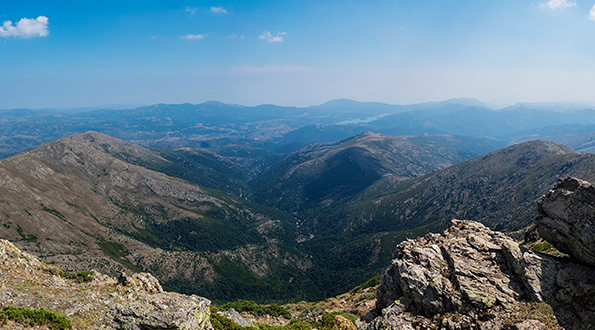
A little further south, between the heights of the Gennargentu and the sea, lies Ogliastra.
Ogliastra has the shape of a natural amphitheatre, protected in a C-shape by the Gennargentu, which outlines its relief and reaches 1834 metres above sea level with its highest peak (Punta La Marmora), making it predominantly mountainous and hilly until the slopes slowly and gradually thin out only near the coast, where it is washed by the Tyrrhenian Sea, between the provinces of Nuoro and Cagliari.
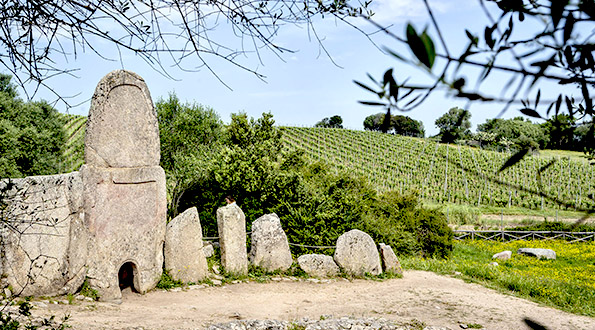
Its mild climate, location and physical conformation make it a more than ideal place for vines.
Constant winds provide excellent ventilation for the grapes and deprive them of any residual moisture that is harmful to their health.
Vine cultivation has very ancient origins in this area, and as far back as the 14th century, there are sources that tell of the trade in wine made from wild grapevines, which thrive everywhere, especially near watercourses and from which a wine with a high polyphenolic and alcohol content is made compared to the vinifera vine.
A place, therefore, where the vine has spontaneously found its preferred habitat, so much so that it grows everywhere. The wild grapevine proliferated, giving rise to the vitae vinifera, but while the former rarely has hermaphrodite plants (with independent reproduction) in the cultivated vinifera vine, hermaphrodite plants are the majority.
This process has significantly affected constant and copious autonomous production throughout the area.
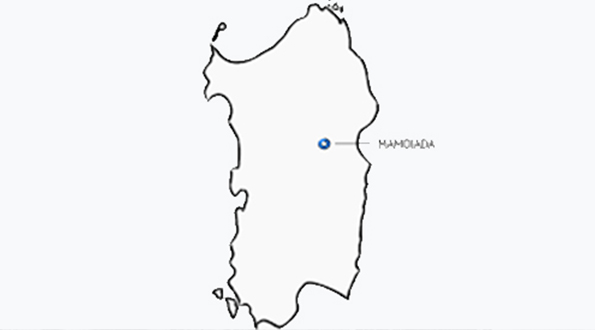
In the heart of the Barbagia of Ollollai we find a very small but rich area: Mamoiada.
Mamoiada is a small village of 2,500 souls, most of whom have always been dedicated to the cultivation of vines. History in Mamoiada is decisive for an in-depth understanding of the wine that is produced: in the post-war period, the 'Cassa per lo Sviluppo del Mezzogiorno' (Southern Italy Development Fund) imposed a social wine cellar in Mamoiada.
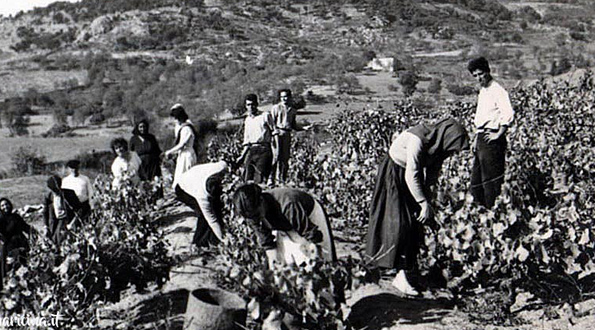
The people of Mamoiada who grew up in the country and are used to making wine in the traditional way are unable to adapt to the demands of big industry, so the cooperative winery soon closes its doors and everyone goes back to making wine in the old-fashioned way, without added flavourings and other artificial chemical processes.
In Mamoiada, the wine of the territory has always been made, genuine, with spontaneous fermentation and minimal intervention.
Today there are about 350 hectares under vine, 400,000 bottles, and more and more young people involved who decide to stay and invest resources in their territory.

The trend is the production of natural wines, with indigenous yeasts, whether they are then organic, biodynamic, without certification is not important, the important thing is the protection of the healthiness of the land and then of the wine.
Here, each vineyard is harvested and vinified separately, because each one has a different expression of the indissoluble bond between man, earth, sky, environment, exposure, etc.
Here territoriality, here more than anywhere else, is atavistic.
After the vine comes the wine, and Cannonau is the undisputed king of Sardinian reds.

Only the vine with its tenacity manages to sink its roots into such impervious places. On soil derived from granite disintegration, sapling cultivation ensures that indissoluble relationship between earth and sky that only lands so exposed to the sun can understand. But this island is such a triumph of diversity that even talking about Cannonau with the associated clichés won't get us very far.
And since we want to look far, Cannonau is not just a wine, not just a grape variety, it is a set of wines, a set of grape varieties, and should be the grape of many different DOCs.
The work being done by the Mamojà association will certainly soon see its fruits.

Amongst all the activities of conservation, communication and promotion of a handkerchief of land and a handful of winegrowers in Mamoiada, there is also the protection and valorisation of Cannonau, which, despite what they would have us believe, is an indigenous Sardinian vine, born in Sardinia and not in Spain, perhaps among the oldest in the world.
Its character can also be found in the character of the Sardinians, who are different in idiom, traditions, culture, and activities; each tiny area is profoundly different from the next, even just a few kilometres apart, yet they are a people united and determined in the defence of their identity.
Here, Cannonau wants the same thing, it is the grape variety of a DOC extended throughout the region and yet it has a thousand faces, from one zone to another it changes in expressiveness.
The idea of the dark, dense, thick Cannonau to be cut like a well-aged pecorino is a bit of a no-go. Of course there are still wines like this to be found, but the winemaker's practice evolves as the climate evolves (or involves) and obviously everything changes depending on where you are.
In Sardinia, too, we will one day have precise and accurate zoning work as we did with the MGAs of Barolo, and then yes, we could talk about the many Cannonau and its varied biodiversity.
It is only thanks to this diversity that indigenous vines like Cannonau will find their greatest value.


